Kawasaki Model Row
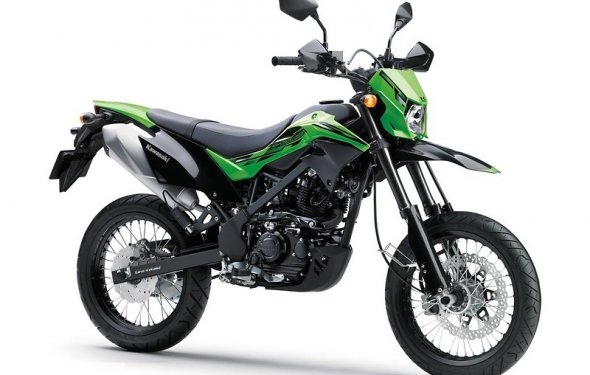
The production of motorcycles under Kawasaki is performed by one of the many units of the Japanese corporation Kawasaki Heavy Industries, Ltd. It was formed in 1963. The company ' s interests have increased significantly since 1887, thanks to the insistence of its founder, Shozo Kawasaki. It's both shipbuilding and aeroplane, heavy industry and space research. The new sphere of activity was developed in replacement of the production of fixed-wing aircraft, which was not restored after the war.
To promote the Kawasaki brand spread in narrow circles, new motorcycles Started to represent a firm on domestic motors. But that niche was already busy, so it had to be uprooted in the ocean markets. To that end, existing models needed to be modernized. The first attempts with Meguro and W1 bikes have become pervasive. The attention of the engineers has shifted to speed characteristics and smooth turns. That's how Kawasaki 500SS MachIII and 650 W1 Commando, which deserved the respect of Americans. Later, the era of the Z model began. In the 1970s, he debuted a road GPZ with a subway Uni-Trak. The sign became the model line of the Vulcan series.
In the post-Soviet Russia, Kawasaki motorcycles were initially debutted with a run delayed. This market segment became more promising in 2006 when a full-fledged dealer network was formed to sell and maintain Japanese technology.
In the supersport category, Kawasaki Ninja models are presented in six versions with 4-stroke 4-cylind engine. The front brakes are two-disclosure and the rear are disc hydraulic. The main difference between motorcycles is engine volume.
To date, the Kawasaki road motorcycle line has two dozen bikes. They have a fuel tank and a suitable planting, although there is a slight inclination on the " green " . The chaining, the suspension is also designed to overcome irregularities on the road. No trailer can be fitted, no anchorages.